- The Nebraska Planner
- Posts
- Carnegie Libraries
Carnegie Libraries
Over a century ago, access to books was a privilege, rather than a right shared by the public. Yet one man’s philanthropic vision changed the landscape of public learning throughout the United States. That man was Andrew Carnegie, a self-made industrialist millionaire with a dream. Between the late 19th and early 20th centuries, Carnegie assisted in funding the construction of over 2,500 libraries across the world, more than 1,600 in the U.S. alone. Carnegie’s libraries not only opened up the availability of books and knowledge to the general public, it laid the foundation for the modern public library system.

Chris Solberg
January 30, 2026

From 1883 to 1929, a total of 2,509 libraries were built with Carnegie’s funding. Of these, 1,689 were built in the United States, 660 in the United Kingdom and Ireland, 125 in Canada, and 25 others in Australia, South Africa, New Zealand, Serbia, Belgium, France, the Caribbean, Mauritius, Malaysia, and Fiji.
Carnegie’s grants were quite significant for the era in which they were handed out. Small towns would receive $10,000 to construct a library that would typically become the community’s most significant amenity. Almost $56.2 million was provided toward the construction of the 2,509 libraries that received funding.
Who was Andrew Carnegie?
Born in Scotland, Andrew Carnegie was quickly drawn to books. This interest would continue after his family immigrated to the United States. He would spend his teen years in Allegheny and Pittsburgh, where he listened to readings and discussions of books from the Trademan’s Subscription Library. A library that his father helped create. This love for books would continue during his early working years, and he would have access to the personal library of Colonel James Anderson.
Colonel Anderson would be instrumental in the foundation of many of Carnegie’s beliefs. Anderson provided books to “working boys” to allow them to acquire knowledge to improve themselves. This is despite the disdain from others who didn’t believe that those less fortunate should have access to such readings. Carnegie became a strong believer in a society based on merit, where anyone could become successful with hard work and determination.
In 1889, Carnegie penned an essay entitled The Gospel of Wealth. Within the essay, he proclaimed that the wealthy had a moral obligation to the new upper class to be philanthropic for the betterment of society. He envisioned that libraries were an ideal way to provide resources to others to improve their lives.
The First Libraries
Colonel Anderson’s philanthropic ways stuck with Carnegie, even after Andrew became wealthy himself. In 1883, the first Carnegie-funded library would open. The first of what would become thousands of libraries for the public to enjoy. But this library wouldn’t be in the United States; the structure was constructed in Dunfermline, Scotland, where he was born.
The first library he funded in the United States was in Allegheny, Pennsylvania, where he was raised after crossing the pond from Scotland. This building would become even more noteworthy as it would also house the first Carnegie Music Hall. Although the first library he funded in the United States was in Allegheny, the first one to open was in Braddock, Pennsylvania, just a short distance from Pittsburgh. Just a few years later, the library was expanded to include the third Carnegie Music Hall in the U.S.
How Fairfield, Iowa, Changed America
Until 1892, Andrew Carnegie’s focus was entirely on areas where he had personal ties. Scotland and Southwestern Pennsylvania benefited from his philanthropic efforts. However, United States Senator James Wilson, of Fairfield, Iowa, was the impetus that changed Carnegie’s view. Although there was a temporary library established in Fairfield, Senator Wilson saw the need to find a permanent home. Wilson lured the interest of his friend Andrew Carnegie to subsidize the construction of a permanent library. Commissioned in 1892, the Fairfield Library would become the first library that Carnegie would fund for a community to which he had no personal ties.
As fate would have it, the Fairfield project would be the spark for a new funding model to be used by Carnegie for 2,800 additional libraries. From that point forward, libraries wouldn’t just be built in Pennsylvania or Iowa, but throughout the United States and various countries in the world.
To this day, the Carnegie Library building in Fairfield still stands and is now on the National Register of Historic Places. However, the library itself moved to a new facility in 1996. The original structure is now home to the Carnegie Historical Museum, which occupies the first and third floors of the building. The second floor houses the Jefferson Center for the Indian Hills Community College. Although the library has moved out of the building, it still provides an educational impact on all three floors.

Fairfield’s Carnegie Museum, Fairfield, Iowa, by oscophotos; Wikimedia CC-BY-SA-4.0
The Carnegie Formula
In 1897, Carnegie hired James Bertram as his personal assistant. His right-hand man, Bertram essentially managed the grant program for Carnegie. He reviewed the grant requests and worked with the local governments to ensure they met the requirements to receive funding.
Most of Carnegie’s libraries were approved for funding under a set of requirements known as the “Carnegie Formula”. The Formula required financial commitments for the operation and maintenance of the libraries to ensure they were supported by the local government into the future. As part of the “Carnegie Formula,” he required the local governments to:
Demonstrate the public need for the library
Provide the land for the construction of the library
Budget at least 10% of the library construction costs within the municipal budget for operation of the library, including:
Funding to maintain the library throughout its lifespan
Funding to pay for library staff
Provide free services to all
A Couple of Remaining Examples
Over the years, a number of these libraries have been demolished or sold to private owners as age and other factors have limited their viability. Many communities have simply outgrown these facilities. However, approximately 800 of Carnegie’s libraries are still in use as libraries.
Red Oak, Iowa
Of course, if I’m going to bring up Carnegie Libraries, I have to mention the one in my hometown. Prior to Carnegie’s assistance, the Red Oak Library was housed in the basement of Houghton State Bank. Looking for a permanent home, the residents of Red Oak looked to Andrew Carnegie. Built in 1909, the library has been a local hub of learning for over 100 years. Like many of these libraries, the Red Oak facility is also on the National Register of Historic Places. This library was highly influential to this blogger’s intellectual development. I can’t count the number of times I have visited this grand structure.

Red Oak Public Library, by Jim Roberts; Wikimedia CC-BY-SA-4.0
Estherville, Iowa
Another good example is the one in Estherville, Iowa. Like many other communities, the library in Estherville had a bit of a gypsy history, temporarily setting up shop at a variety of locations. However, city officials worked to obtain a grant from Carnegie. With the grant’s assistance, the ribbon was cut on the new building in 1903.
The community has held tight to the structure. Needing to expand to meet the needs of the community, Estherville added on to the library rather than moving on from it. Other communities like Madison, Minnesota, and Manitou Springs, Colorado, have decided to do the same.
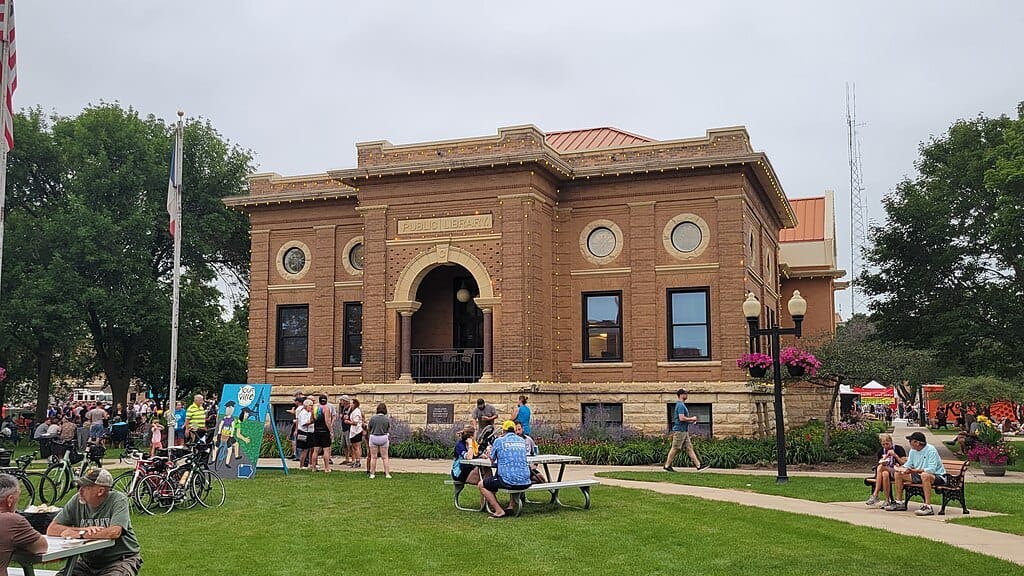
Estherville Public Library, Estherville, Iowa, by RuralResurrection; Wikimedia
Adaptive Reuse
Many communities have outgrown their Carnegie Library over the many decades since these libraries were built. Other communities have moved to new facilities due to the maintenance costs tied to these aging structures. But these beautiful structures are often quickly snatched up by someone in the private sector. Many have since become ideal examples of adaptive reuse, as purchasers often have an eager eye towards renovating these storied buildings.
Charles City, Iowa
Charles City’s library opened on the corner of Jackson and Kelly Streets in 1904 and was funded through the help of a $12,500 grant from Andrew Carnegie. As the community outgrew the original building, they constructed a new facility that opened in 1979. Since then, the original library has been converted to the Charles City Art Center. Funded by memberships, grants, private donations, and our small endowment fund, the Art Center is free to the public.

Charles City Art Center
Other Examples
Numerous other Carnegie Libraries have been transformed from their existing roots into housing a new use. In Cedar Rapids, Iowa, the former library is hosting art as well, but as a wing to a larger art museum. The Carnegie library in North Platte, Nebraska now serves as a children’s museum. In Aledo, Illinois, the building has been transformed into a co-working facility for technology education, recruiting and employment. Xenia, Ohio, had a master plan developed that presented three potential options for redevelopers. The library in Olympia, Washington, has even been converted into a “Whiskey Library”.
A Lasting Legacy
Though the original Carnegie library program ended in 1929, the impact of the program continues to this day. Regardless of whether these buildings are still being utilized as libraries in Carnegie’s original intent or repurposed through adaptive reuse, most are still having an impact on their communities.
Carnegie libraries were revolutionary in that they made knowledge freely accessible to all, regardless of class, race, or education. Many of these libraries have been openly celebrated over the years as community hubs and sources for information. They were built with sound construction standards, many of them beautifully adorned with brickwork.
These historic structures have stood the test of time and serve as iconic, historical monuments closely linked to the sense of community in many towns across the United States. The communities that were fortunate enough to receive funding through Andrew Carnegie’s philanthropic efforts should celebrate what they have.
Reprinted article from: https://ruralresurrection.com/carnegie-libraries/. Thumbnail photo is of the Albert Lea Carnegie Library, by McGhiever; Wikimedia CC-BY-SA-4.0.
---
About Chris Solberg
Though Christopher Solberg (AICP) works in a suburb of a metropolitan area, his roots are in Red Oak, Iowa, a community of 5,500 persons southeast of Omaha. He has spent a significant amount of his career helping small towns. Through his time working for a regional planning association and for a private consultant Chris has helped numerous small towns throughout Iowa and Nebraska. Chris was the President of the Nebraska Planning and Zoning Association (NPZA) for eight years and a member of both the NPZA and NE APA Nebraska boards.
Reply